test
Sourcing heavy-gauge thermoformed parts from China can cut part cost substantially, but the quotes you collect will look nearly identical on paper. Every supplier lists ABS, PC, and PP; every factory claims tight tolerances. The real differences sit in sheet handling, wall-thickness control, trimming accuracy, and the test standards a supplier will commit to in writing. This guide gives procurement engineers a practical checklist for evaluating a vacuum forming supplier before tooling money is committed.
- Verify the supplier’s stated sheet thickness range (0.5–15 mm at ZetarVac) and maximum forming length (about 2,500 mm) against your part envelope before requesting tooling quotes.
- Ask for measured wall-thickness distribution on a formed sample, not just the starting sheet gauge.
- Confirm five-axis CNC trimming capability for mounting holes and mating edges on large formed parts.
- Require named test standards — ISO 527-2, ASTM D790, ISO 75-2, UL 94, IEC 60529 — in quotations and inspection plans.
- Compare quotations on identical scope: tooling, forming, trimming, finishing, packaging, and freight terms.
- Run a pilot lot under normal production conditions before releasing mass production.
[lwptoc min=”2″ depth=”2″ title=”Contents” numeration=”none” toggle=”1″]
What Does a Capable Heavy-Gauge Thermoforming Supplier Look Like?
A capable supplier combines forming machines sized to your part envelope, a documented material library, in-house five-axis trimming, and inspection practices tied to recognized plastics test standards. When any one of these is missing or outsourced, the risk does not disappear — it quietly moves onto your project.
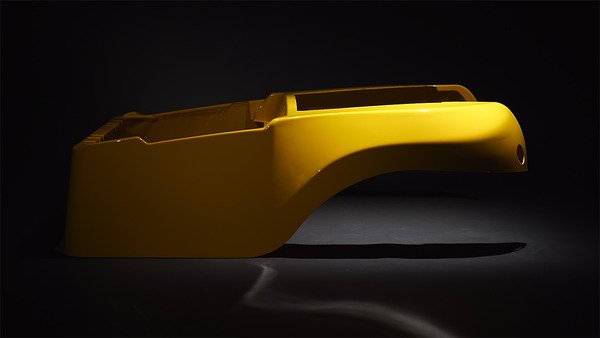
Heavy-gauge thermoforming, sometimes called heavy gauge or thick-gauge forming, is the side of the process that works sheet measured in millimeters rather than fractions — ZetarVac processes 0.5–15 mm and forms parts up to about 2,500 mm long. It produces equipment housings, machine covers, material-handling trays, and structural components — parts that carry load, shield electronics, and survive industrial handling. This is a different discipline from thin-gauge packaging work, and a supplier’s history in one does not automatically qualify them in the other.
When you shortlist suppliers, ask three things in writing: the sheet thickness range they process, the maximum forming length their largest machine can hold, and how trimmed outlines are produced. Vague answers here predict problems later. A plant that forms 0.5–15 mm sheet and handles parts up to about 2,500 mm can cover enclosures, trays, and covers within one program instead of splitting the work.
ZetarVac operates more than 20 vacuum forming and thermoforming machines across 45+ total production lines, processes sheet from 0.5 to 15 mm, and forms parts up to about 2,500 mm in length. For a buyer, that means large curved housings and multi-cavity trays can be formed and trimmed in one plant, without outsourcing the forming step to a third party.
Which Equipment and Material Capabilities Should You Verify First?
Start with the sheet, because every downstream property depends on it. Confirm in writing that the supplier processes the gauge your part needs, and ask which machine carries your platen size. If your part sits near the edge of the stated forming envelope, request the tooling layout and clamping arrangement before you accept the quote.
Next, test the material library. A working library maps each polymer to the applications it serves: ABS for equipment housings, cases, and automotive interiors; HDPE for industrial trays and liners; PP for trays and boxes; PC for clear guards; PMMA for luminaires and displays; PC/ABS and ASA for housings needing impact strength or weather resistance; PP/GF for structural parts; TPE, TPU, and TPV for soft liners, sleeves, and seals. If a supplier quotes every polymer at the same price and cycle time, they are quoting from a brochure rather than from production experience.
For parts that live near heat — motor covers, luminaire housings, enclosures mounted beside drives — ask for the heat deflection temperature of the specific grade. ISO 75-21 is the standard that specifies how deflection temperature under flexural load is measured, and it is the number that tells you whether a formed cover will sag when it sits next to a hot component in service.
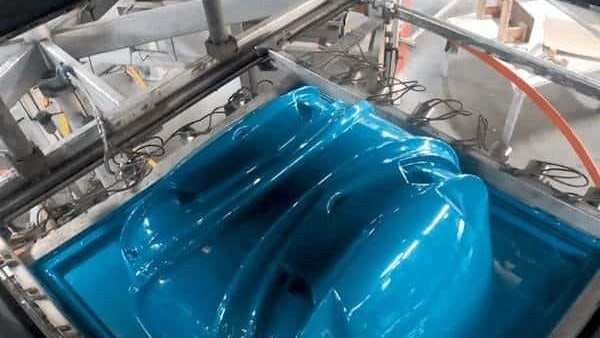
"A thicker starting sheet always produces a stronger formed part."False
Thermoforming stretches the sheet non-uniformly, so deep draws and corner radii thin out while flat areas stay close to nominal. Strength follows the thinnest section, not the starting gauge. The result is a part that passes a flat-panel check yet cracks at a radius in service.
"Measured wall-thickness distribution on the formed part predicts real strength."True
Ask suppliers to report thickness at the deepest draw, the corner radii, and the flanges, taken from a formed sample rather than a calculation. Suppliers who measure this during trial forming can adjust heater zones, plug geometry, and vacuum sequencing before the part ever reaches your assembly line.
The same logic applies to quotes. If two suppliers quote the same 5 mm ABS enclosure, the one who volunteers a thickness map at the corners is showing you how they control the process — and how they will handle it when your drawing gets harder.
How Should You Audit the Forming Process and Trimming Cell?
On the floor, audit two things: how consistently the forming cycle is controlled, and how accurately trimmed outlines are produced. Sheet temperature, vacuum ramp-up, plug assist, and cooling time decide repeatability; the trimming cell decides whether mounting holes and mating edges land where the drawing says.
Walk the forming cell and look for evidence of process control. Industrial vacuum forming typically pulls vacuum in the range of roughly 0.08–0.095 MPa, and cycle behavior depends on heater zoning across the sheet, sheet temperature at forming, and cooling time under pressure. Ask how heater zones are set for your material, whether sheet temperatures are recorded by shift, and how a new sheet batch is qualified. A supplier who documents these variables can reproduce your part after a material change; one who adjusts by eye cannot.
Then walk the trimming cell. Five-axis CNC trimming keeps the trimmed outline registered to the forming tool, which matters for mounting holes, sealing flanges, and parts that mate with stamped brackets. Ask what tolerance the supplier holds on trimmed edges for parts at your size, and request a sample report. The DFM checklist for heavy-gauge thermoformed parts and molds covers draft angles, radii, and undercuts — walk it with your supplier before tooling steel is cut.
For structural parts that carry load, tensile data belongs in the qualification package. ISO 527-22 is the standard tensile test used on thermoformed sheet and formed parts, and it is what makes material data sheets from different suppliers comparable on a like-for-like basis.
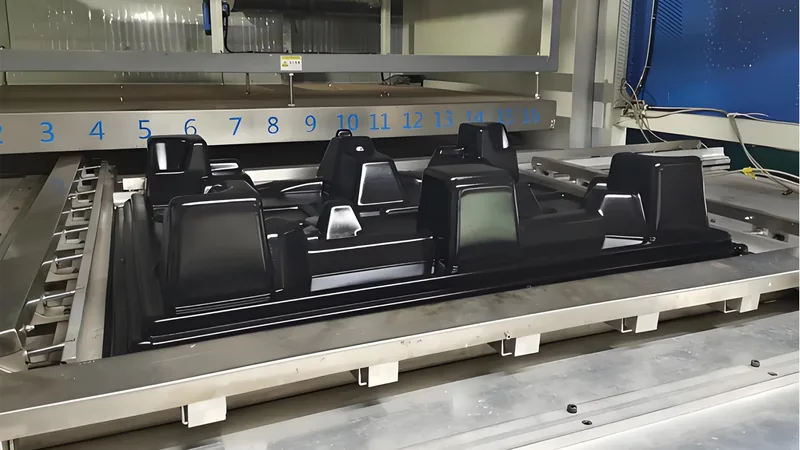
"Passing first article inspection means the supplier is ready for mass production."False
A first article is produced under the best conditions the shop can arrange: fresh sheet, tuned heaters, an attentive crew. Production runs across shifts, operators, and material lots, where variation accumulates. Parts that drift out of tolerance in week three cost far more than the audit that would have caught it.
"A pilot lot run across normal production shifts reveals process capability."True
Ask for a pilot batch of 50–200 parts produced under standard conditions, then measure critical dimensions and thickness across the lot. The spread tells you the real process capability. Suppliers confident in their cycle control will agree to this; hesitation is itself a finding.
Which Standards Should the Supplier Quote Against?
A serious supplier names the standards in the quotation and the inspection plan: ISO 527-2 or ASTM D638 for tensile data, ASTM D790 for panel stiffness, ISO 75-2 for heat deflection, UL 94 for flammability, and IEC 60529 for ingress protection on formed covers. Named standards make claims checkable and quotes comparable.
Three of these deserve specific attention for enclosures and covers. UL 943 classifies the flammability of plastic materials, and many electrical equipment housings are specified with a minimum V-rating depending on the end product’s requirements. IEC 605294 defines the IP code — the degrees of protection an enclosure provides against dust and water — and it is the reference behind any IP-rated formed cover or machine guard. ASTM D7905 specifies the flexural test used to describe the stiffness of formed panels and enclosure walls, which is the property that decides whether a large flat cover drums or flexes in service.
Ask each shortlisted supplier which of these standards they test in-house and which they send to a third-party laboratory. Neither answer is wrong, but the question reveals how familiar the quality team is with formed parts — and whether their inspection plan was written for thermoforming or copied from an injection molding template.
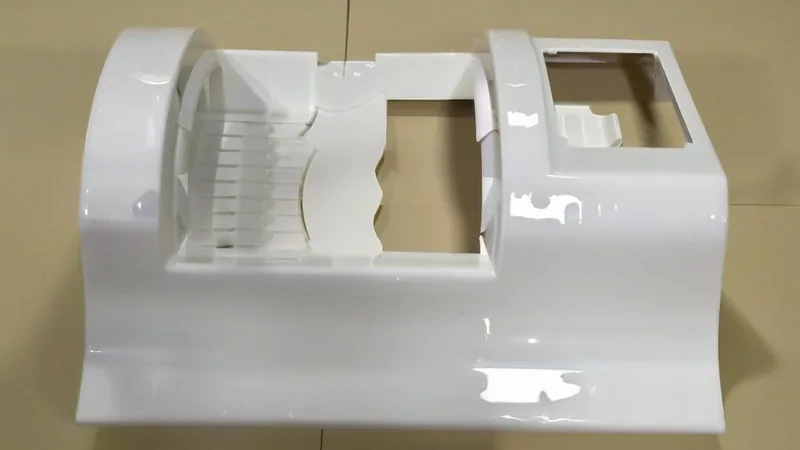
ZetarVac’s material library maps grades to applications: ABS for equipment housings and automotive interiors, PC for clear guards and protection covers, ASA for outdoor equipment housings and automotive exterior parts, and PP/GF for structural automotive and industrial parts. Ask a shortlisted supplier to map your application to a grade and explain the reasoning — the mapping itself is a capability test.
What Should a Side-by-Side Quote Comparison Include?
Compare quotations line by line on identical scope: tooling, material, forming, trimming, secondary operations, finishing, packaging, and freight terms. The lowest number is meaningless until the scope behind it is the same drawing revision, the same material specification, and the same inspection requirements.
| Quote line | What to verify | Red flag |
|---|---|---|
| Tooling | Mold material, cavity count, maintenance terms, ownership | Lump-sum tooling with no maintenance clause |
| Material | Grade, gauge, sheet source, UV or flame package | Generic ABS with no grade or specification |
| Forming | Machine size, cycle time, thickness report on sample | No wall-thickness data offered |
| Trimming | Five-axis CNC, fixture method, tolerance on trimmed edges | Manual trimming quoted for tight outlines |
| Secondary operations | Bonding, hardware insertion, painting, decoration | Vague as-required line items |
| Packaging | Layer protection, dunnage, export cartons | Bulk packing for cosmetic surfaces |
| Commercial terms | Incoterms, payment milestones, rework policy | Full payment before first article approval |
"The lowest unit price is the cheapest option over the program’s life."False
Low quotes frequently exclude trimming fixtures, finishing, or export packaging, and the difference surfaces later as change orders. Scrap and rework compound the gap: a line that runs 5% reject costs more than a higher quote with stable output. Compare total landed cost per acceptable part instead.
"Quotes are comparable only when scope, tolerances, and inspection plans match."True
Normalize every quotation to the same drawing revision, the same material specification with named standards, and the same inspection requirements before comparing prices. Once the scope is identical, a price difference tells you something real about efficiency — not about what was quietly left out.
When the buyer is ready to compare suppliers, this normalization step is the single highest-leverage hour in the whole evaluation. It converts marketing claims into a like-for-like table your team can defend internally.
How Do You Validate a Supplier Before Mass Production?
Run a staged validation: prototype parts for fit and function, a pilot lot under normal production conditions, then a documented first article with a dimensioned inspection report. Each stage answers a different question — geometry, process stability, and conformance — and skipping a stage means that question gets answered later, on your line, at your cost.
On the pilot parts, inspect critical dimensions against the drawing’s GD&T framework6, measure wall thickness at the sections that carry load, check cosmetic surfaces under defined lighting, and run an assembly trial with the mating components. Agree on the measurement plan before the pilot runs, so both teams measure the same features the same way.
Ask how your program fits into the plant’s running capacity, and what happens when your volume doubles. The answer shows whether the pilot line and the production line are the same machines — which is what you want — or whether your process window will be re-proven on equipment you never audited.
ZetarVac’s reference monthly capacity is about 100,000–200,000 pieces, and prototyping, small batch, and large batch production are supported on the same plant floor. For a buyer, that means the process window proven on a pilot lot can carry into volume production without moving the program to a different line or factory.
FAQ
What sheet thickness range defines heavy-gauge thermoforming?
Heavy-gauge work means the thicker end of the sheet range, where formed walls carry load and the process behaves differently from thin packaging work; ZetarVac processes 0.5–15 mm on its thermoforming lines. The practical limit for a given part is set by the machine’s heating capacity and forming length — about 2,500 mm here — rather than by the process itself.
Can a vacuum formed housing meet ingress protection requirements?
Yes, when the design supports it. The IP rating defined by IEC 60529 depends on gasketed joints, overlapped flanges, and fastener layout as much as on the forming itself, so bring the sealing concept into the DFM discussion before tooling is cut.
How is trimmed accuracy achieved on large formed parts?
Through five-axis CNC trimming with the formed part held in a dedicated fixture, so the trimmed outline stays registered to the forming tool. Ask which tolerance the supplier holds on trimmed edges for a part at your size, and ask for a sample dimensional report.
Can one supplier support prototypes and volume production from the same tooling?
Yes, when prototype, small batch, and large batch production run on the same plant floor. Confirm that your pilot lots run on the same machines and the same trimming cell planned for volume output, so the process window you approve is the one that ships.
Which material suits an outdoor equipment enclosure?
ASA is the standard choice for outdoor housings because it holds color and resists weathering; PC/ABS suits housings needing higher impact strength. For clear protection covers, PC is the usual formed choice. Ask for the grade’s weathering basis, not just the polymer name.
If you are comparing suppliers now, review our thermoforming and vacuum forming service scope or contact our team with your part drawings and target volumes to request a quotation and a technical review of your parts.
-
ISO 75-2: ISO 75-2 specifies the test method for determining the deflection temperature of plastics under flexural load, commonly used to judge heat resistance of formed parts. ↩
-
ISO 527-2: ISO 527-2 specifies the test method for determining the tensile properties of plastics, the standard tensile test run on thermoformed sheet. ↩
-
UL 94: UL 94 classifies the flammability of plastic materials, a frequent requirement for equipment enclosures and housings. ↩
-
IEC 60529: IEC 60529 defines the IP code, the degrees of protection provided by enclosures against dust and water ingress. ↩
-
ASTM D790: ASTM D790 specifies the test method for flexural properties of plastics, used to describe the stiffness of formed panels and enclosures. ↩
-
GD&T: GD&T stands for Geometric Dimensioning and Tolerancing, a standardized system for defining engineering tolerances on drawings. ↩
Related reading

Foam Roller for Beginners: How to Choose and Use One
A beginner-friendly guide to choosing and using a foam roller: types, density, texture, safe technique, and a six-minute…